144 recoveries, one carefully bounded task
The earlier recovery experiment proved that the pieces connected. This follow-up asks whether adding recent conversation history helps a worker resume after an independent reviewer has repaired the code.
Key finding
All 144 supervised continuations completed; a smaller handoff used fewer worker tokens.
Edited finding from the pinned experiment record. The report and figure metadata preserve the original workload and limits.
The boundary
One interval-merging task, seven unchanged acceptance cases and six synthetic failure histories. This measures the supervised system, not standalone Qwen accuracy.
Data
Reviewed aggregate results with explicit units, sources and qualification limits. Different cohorts remain separate.
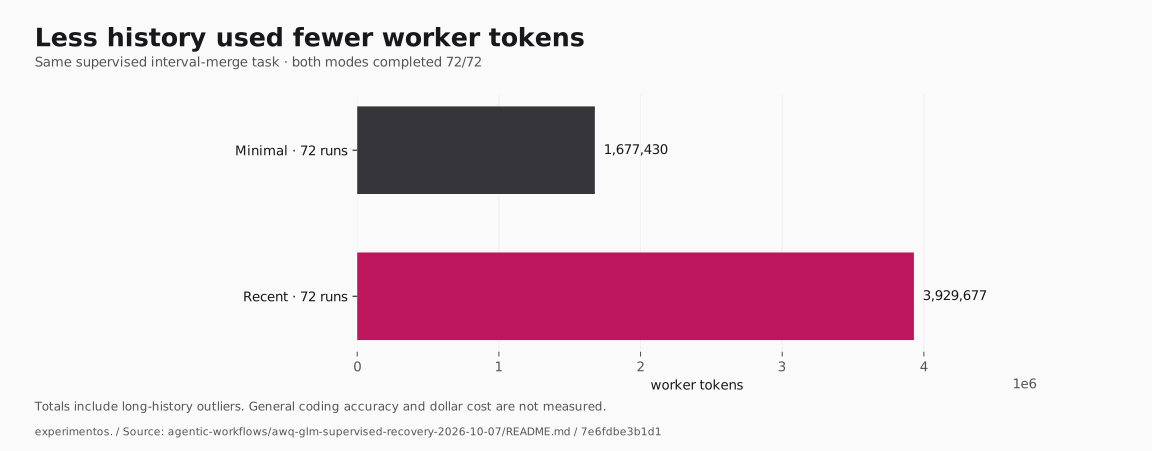
Less history used fewer worker tokens
Same supervised interval-merge task · both modes completed 72/72
- Minimal · 72 runs1,677,430
- Recent · 72 runs3,929,677
worker tokens
Totals include long-history outliers. General coding accuracy and dollar cost are not measured.
View data & source
| Configuration | Value |
|---|---|
| Minimal · 72 runs | 1,677,430 |
| Recent · 72 runs | 3,929,677 |
Origin: reviewed report table. Revision 7e6fdbe3b1d1.
Write-ups
Report agentic-workflows/awq-glm-supervised-recovery-2026-10-07/README.md
Can a compact handoff preserve recovery?
The earlier recovery experiment proved that the pieces connected. This follow-up asks whether adding recent conversation history helps a worker resume after an independent reviewer has repaired the code.
The worker was a selectively quantized Qwen3.8-27B across two RTX 3090s. GLM repaired all 18 initial bundles. Each validated handoff and patch then reached eight matched continuations. Three harnesses, two reasoning efforts, two context modes, six histories and two repeats produced 144 scored continuations.
The result
142 passed after the first handoff; two needed a second review. All 144 eventually passed the original acceptance checks. Both context modes completed 72/72, with 71/72 first-handoff passes each.
Minimal context used 1,677,430 worker tokens; recent history used 3,929,677. Across all six matched harness/effort comparisons, recent context increased paired median worker time by 8.9–203.2% and coding tokens by 3.2–184.0%. Long-history outliers influence the totals, so the paired comparisons matter more than a single aggregate ratio.
What I would keep
Minimal is the provisional choice for this workflow. Installed recovery defaults were left unchanged. Scored worker, summarizer and reviewer usage totals 9,717,148 tokens; shared first-bundle work is counted once. That token total does not imply a dollar cost.
The next useful test is a broader task corpus. Repeating one task under different failure histories demonstrates recovery behavior, while leaving general coding competence unresolved.
Evidence and publication boundary
This is an edited account of the recorded experiment. The linked archive is private; the methods, aggregate findings and limits are included above. Reference recordings, raw conversations, authentication material and workstation configuration are excluded.
More in Agents & systems
A coding agent that knows when to ask for help
A coding agent can keep repeating a failed approach. This experiment gave a local Qwen worker an independent reviewer, then checked whether it could recover without weakening the final acceptance tests.
Three live recovery scenarios passed, each finishing with 10/10 checks.
A model proxy earns its promotion
A proxy must keep its serving contracts while managing several local model families. This promotion record follows the merge through regression checks and separates new live validation from code-reviewed operational notes.
The promoted merge passed 107 tests with one environmental skip.