What six bits preserved in Chatterbox Turbo
Five checkpoints were compared in two cohorts. Complete generations allow speech-token choices and pacing to change. Controlled decoder runs reuse the original tokens and conditioning, allowing a narrower acoustic comparison.
Key finding
Community affine 6-bit had the closest controlled decoder output among the tested quantized candidates; oQ6 led the new oQ variants.
Edited finding from the pinned experiment record. The report and figure metadata preserve the original workload and limits.
The boundary
Three English sentences, one seed and one default voice. In-family cosine and spectral error are not a percentage of human-perceived quality.
Data
Reviewed aggregate results with explicit units, sources and qualification limits. Different cohorts remain separate.
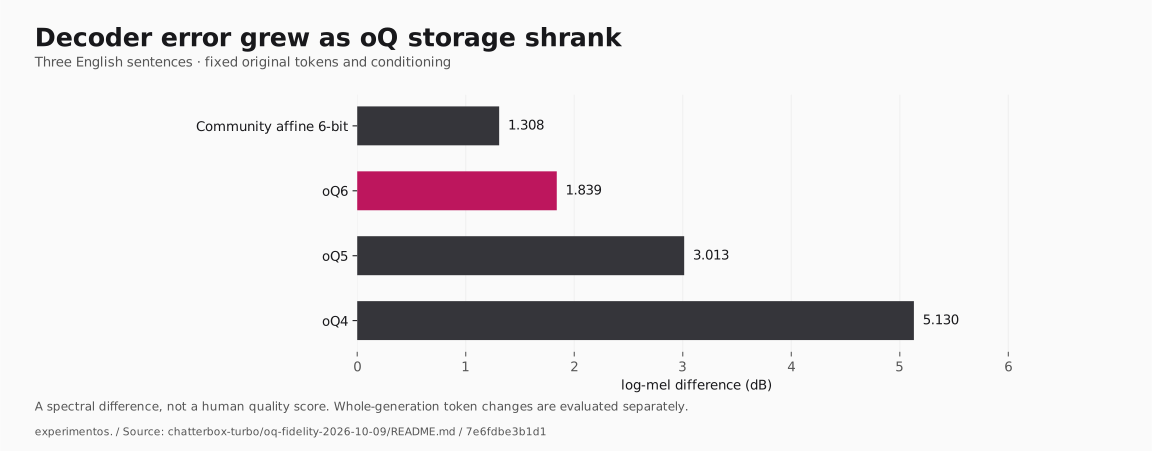
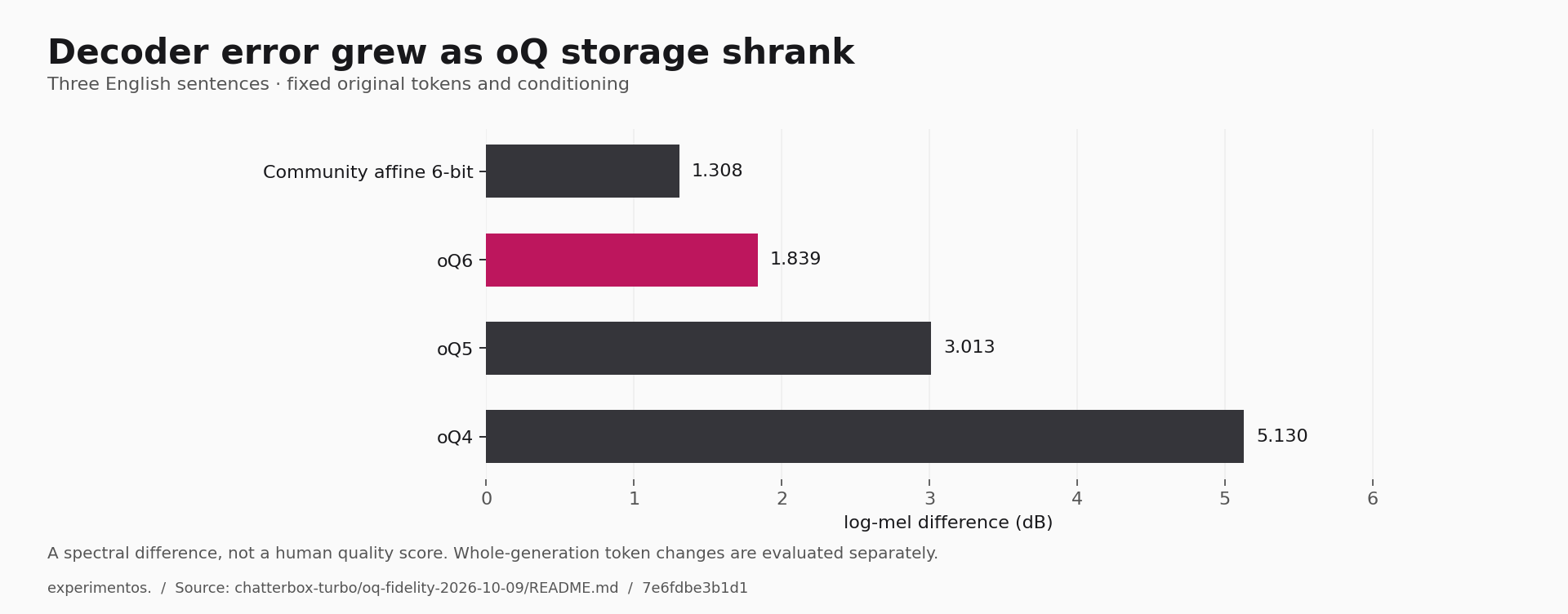
Decoder error grew as oQ storage shrank
Three English sentences · fixed original tokens and conditioning
- Community affine 6-bit1.308
- oQ61.839
- oQ53.013
- oQ45.130
log-mel difference (dB)
A spectral difference, not a human quality score. Whole-generation token changes are evaluated separately.
View data & source
| Configuration | Value |
|---|---|
| Community affine 6-bit | 1.308 |
| oQ6 | 1.839 |
| oQ5 | 3.013 |
| oQ4 | 5.130 |
Origin: reviewed report table. Revision 7e6fdbe3b1d1.
Write-ups
Report chatterbox-turbo/oq-fidelity-2026-10-09/README.md
Separate token choices from decoding
Five checkpoints were compared in two cohorts. Complete generations allow speech-token choices and pacing to change. Controlled decoder runs reuse the original tokens and conditioning, allowing a narrower acoustic comparison.
The supposedly fp16 source actually stored FP32 weights. Inspecting the tensors corrected that label before drawing storage conclusions.
What the controls showed
Community 6-bit used 534.6 MiB, versus 2,847.7 MiB for the original. Controlled speaker cosine was 0.99908 and log-mel difference 1.308 dB. oQ6 measured 0.99618 and 1.839 dB; oQ5 and oQ4 moved farther away. Full-generation speaker cosine was almost tied between community 6-bit and oQ6, near 0.966.
The oQ files contained 318 convolution tensors that had been quantized and subsequently stored in fp16. Dequantizing them made a loadable floating representation; it did not restore the original values.
Timing needs its conditions
The first run used battery power with Low Power Mode enabled. Community 6-bit, oQ5 and oQ4 occupied a similar observed speed band, while oQ6 varied substantially. Those observations do not identify a universal speed winner.
Keep community 6-bit as the provisional candidate for this default English workload. More text, multiple voices, independent encoders and blinded listening are the next useful evidence.
Evidence and publication boundary
This is an edited account of the recorded experiment. The linked archive is private; the methods, aggregate findings and limits are included above. Reference recordings, raw conversations, authentication material and workstation configuration are excluded.
More in Speech & codecs
MOSS on a 3090: Q2 failed, AWQ4 stayed closer
Every profile began with the pinned BF16 generator. The comparison reused fixed reference codes and an FP32 decoder for the main quality measurements, keeping codec changes separate from generator quantization.
AWQ4 stayed close to the BF16 reference on WavLM and character errors; the sensitivity Q2 candidate was rejected.
Drama3: BF16 decoded the same codes about three times faster
The experiment replayed saved Spanish and English codes representing 21.5481 and 15.8824 seconds of audio. It compared FP32, BF16, mixed BF16 and two INT8 decoder variants on one RTX 3090.
BF16 reduced median decoder time from 390.07 to 129.54 ms in Spanish and from 292.42 to 96.88 ms in English.
Keeping FP32 and moving Supertonic to Triton
Rather than reduce the CPU graph precision again, this follow-up used NVIDIA Triton’s ONNX backend with CUDA execution and the unchanged FP32 graphs. The paired comparison retained both speed and acoustic checks.
The paired GPU test cut median first-audio time to about 0.35 seconds while preserving the measured ASR results.